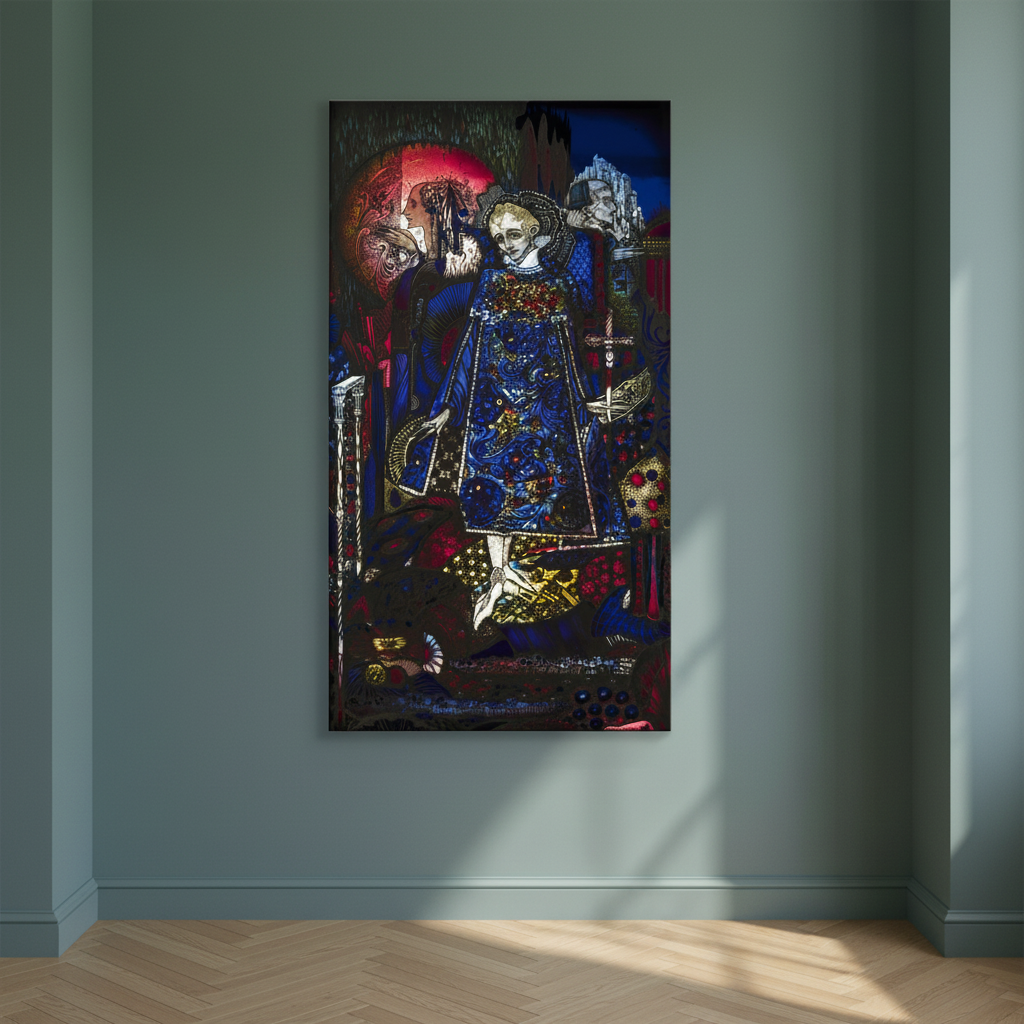
Harry Clarke: the blues, the books, and the window Ireland refused to send
In March 1917 the writer Edith Somerville went to see the new windows in the Honan Chapel in Cork, and wrote to her brother about them. They had, she said, "a kind of hellish splendour — in a chapel dedicated to the Infernal Deities they would be exactly right, gorgeous and sinful." Of one figure's robe she wrote: "The blue robe, for instance, hits your eye like a living flame or a blast of wind."
She commissioned a window from the artist shortly afterwards. He was twenty-eight.
North Frederick Street
Harry Clarke was born in Dublin on St Patrick's Day, 1889. His father Joshua had set up a church-decorating business in 1886 at 33 North Frederick Street and added a stained-glass workshop by the 1890s, so Clarke grew up in a building where glass was cut, fired and leaded as a matter of ordinary trade. He was apprenticed into it at eighteen.
He took evening classes at the Dublin Metropolitan School of Art from 1905 and went full-time from 1910 on annual scholarships, studying under A. E. Child, the school's stained-glass master and a pupil of Christopher Whall. He won gold medals in the Board of Education's national competitions repeatedly in the early 1910s — the first Irish student to take the top prize.
The decisive year was 1914, when a travelling scholarship sent him to France to study medieval glass. He went to Chartres. Everything that follows — the depth of the blues, the refusal to let a window be merely decorative — starts there.
What he actually did to the glass
Clarke's colour is often described as though it were a pigment he alone possessed. It was not. It was a process, and it is worth understanding, because it explains why photographs of his windows never quite convince.
Flashed glass is clear or pale glass with a wafer-thin skin of colour fused onto one face. Clarke painted the areas he wanted to keep with an acid resist and bathed the sheet in acid, eating the coloured skin away in stages — so a single piece could shade from deep ruby to near-white without a lead line crossing it anywhere.
Then he went further. He plated sheets: two differently coloured pieces sandwiched and leaded as one, each separately etched, so the light passes through two filters before it reaches you. That is where the famous Clarke blue comes from. Not a colour, a depth. He also worked back into the painted surface with a needle, scratching detail out of the paint rather than adding it, and he hid his lead lines inside the architecture of the design so the picture would not be interrupted.
The Hugh Lane Gallery, which holds his Eve of St Agnes, calls it "painstaking work of the utmost complexity". He was doing it in miniature before he did it at scale.
The Honan Chapel
The commission that made him came in 1915: eleven of the nineteen windows in the Honan Chapel at University College Cork, finished by 1917. The other eight are by An Túr Gloine. His St Gobnait window of 1916 is the most photographed — Gobnait being the patron of bees, Clarke set her in tracery of honeycomb.
What followed ran for the rest of his life and across sixteen Irish counties: Ss Peter and Paul in Phibsborough, Holy Trinity in Killiney, the Church of the Assumption in Wexford, St Joseph's in Terenure, the Sacred Heart in Donnybrook, the Life of Christ windows at the Díseart in Dingle, fourteen windows at St Patrick's Purgatory on Lough Derg, the Ascension in Brisbane. Estimates of his total output vary; more than 130 windows is the conservative figure.
In 1927 Ernest Bewley commissioned six windows for his new Oriental Café on Grafton Street — four panels of the classical architectural orders, plus two called Swan Yard, alive with butterflies, flowers and sea creatures. They were installed in 1928 and are still there. In February 2026 the Supreme Court ruled that they belong to the owner of the building rather than to the café that operates in it, having been "specially commissioned and designed to be an essential part of the fabric of the premises."

The books
Alongside the glass, Clarke made his living as an illustrator for the London publisher George G. Harrap, and it is through the books that most people first meet him.
Andersen's Fairy Tales came first, in 1916: sixteen colour plates and twenty-four full-page black-and-white drawings. Then Poe's Tales of Mystery and Imagination in 1919 — twenty-four monochrome plates, no colour at all, and still the definitive visual reading of Poe nearly a century later. The 1923 edition added eight colour plates. Perrault's Fairy Tales followed in 1922, and Goethe's Faust in 1925, with eight colour plates and some seventy further images.
Harrap looked at the Faust drawings and called them "full of stench and steaming horrors". Clarke's reply is the best single line about his own work: they were, he said, "terribly, terribly sincere… 'tis horrid, I know — in fact, I had to laugh at my creations or I would have become morbid." A contemporary reviewer called them "the world of the psychoanalyst made visible."
The window Ireland refused
In the mid-1920s the Irish Free State commissioned Clarke to make a window as its gift to the International Labour Office of the League of Nations in Geneva. He worked on it for years. Finished in 1930, it is eight panels showing scenes from fifteen modern Irish writers — Yeats, Shaw, Synge, O'Casey, Joyce, Lady Gregory, Pearse, AE, Colum, Stephens, Lennox Robinson, Seumas O'Sullivan, Seumas O'Kelly, George Fitzmaurice and Liam O'Flaherty.
Thomas Bodkin, later Director of the National Gallery of Ireland, called it "the loveliest thing ever made by an Irishman".
In September 1930 W. T. Cosgrave, President of the Executive Council, declined to send it. His letter conceded that the window was "a most remarkable and successful artistic achievement", but held that the "inclusion of scenes from certain authors as representative of Irish literature and culture would give grave offence to many of our people." The particular offence appears to have been the panel for O'Flaherty's Mr Gilhooley, which shows a near-nude veiled dancer. Behind that lay a broader unease: drink, poverty, Protestant authors, and a satire of the young state, none of it the Ireland the government wished to hand to the world.
Clarke died in January 1931 before he could alter it. In 1933 the State sold the window back to his widow, the painter Margaret Clarke, for £450 — exactly what it had paid. In 1988 his sons sold it to the collector Mitchell Wolfson Jr. It is now in Miami Beach, at the Wolfsonian–FIU.

Chur, January 1931
He was diagnosed with tuberculosis in 1929 and spent fourteen months at a sanatorium in Davos, then returned there in October 1930. In the first days of January 1931 he left, trying to get home to Ireland, and died at Chur in the Swiss Alps on 6 January. He was forty-one.
He was buried at Chur, at his own request. Swiss practice required the grave lease to be renewed; the family, it seems, were never told. The headstone lasted about fifteen years. There is now no memorial to Harry Clarke in the graveyard where he lies.
His studios kept working in Dublin until 1973.
Where to see him, and how to live with him
The windows are still where he put them, and most of them are free to visit: the Honan Chapel in Cork, the Díseart in Dingle, Terenure, Phibsborough, Donnybrook, Lough Derg. The Eve of St Agnes is at the Hugh Lane in Dublin. The Bewley's windows are on Grafton Street, and you can look at them over a coffee.
Clarke died in 1931, so under the life-plus-seventy rule his work has been in the public domain in Ireland and across the EU since 1 January 2002. That is why the book plates can be printed at all.
Browse our Harry Clarke prints — the Poe and Andersen plates, the textile designs, and The Song of the Mad Prince on canvas. Archival paper, framed or unframed, free worldwide shipping.