

The Celtic Tree of Life: what the symbol means, and what Ireland actually believed about trees
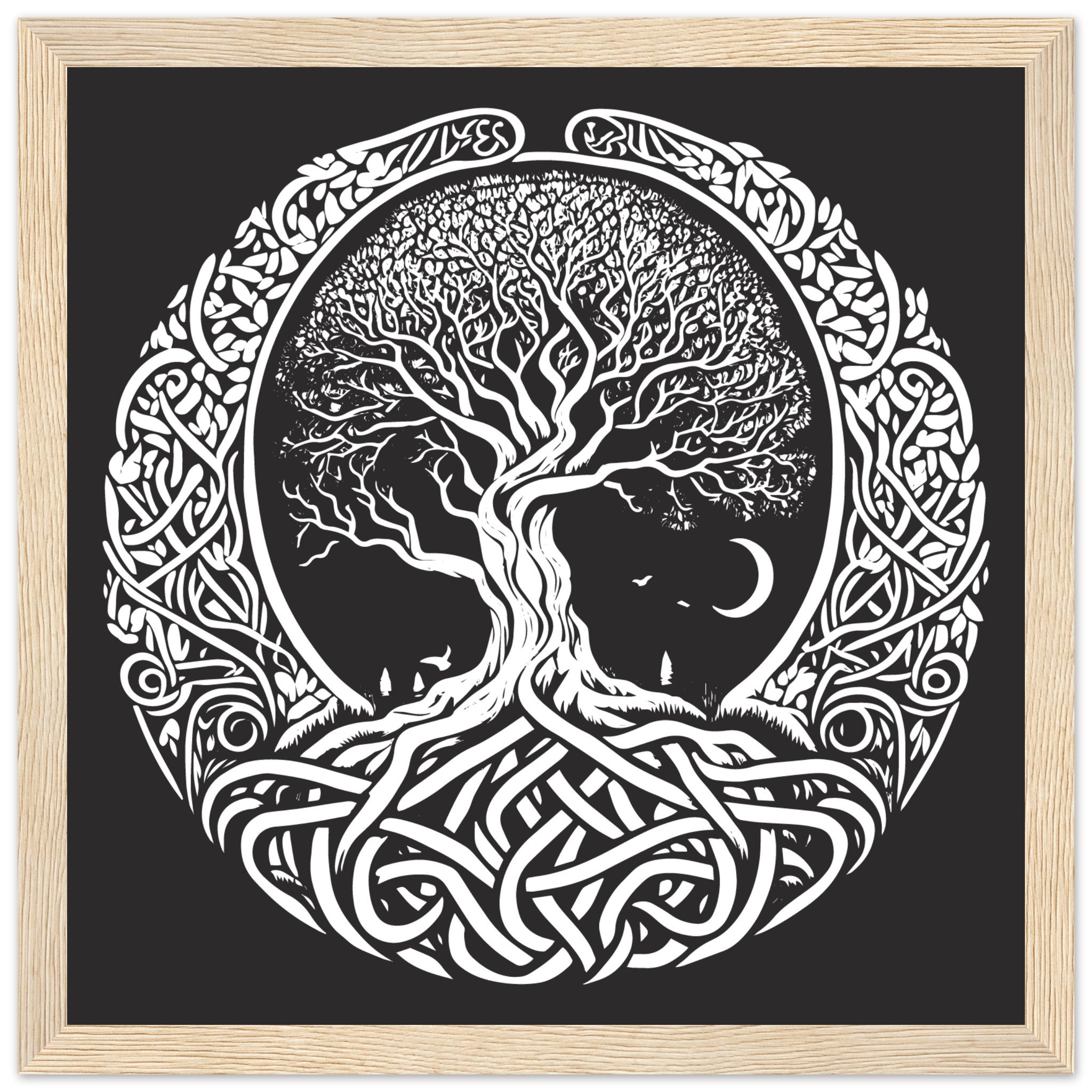
You have seen it a thousand times: a tree inside a circle, branches curling up and roots curling down, the two meeting at the rim so the whole thing closes on itself. It is on pendants, on wedding rings, on wall prints, tattooed on shoulders. It is usually captioned Crann Bethadh — the tree of life.
Here is the part the caption leaves out. That particular design is modern. No medieval Irish manuscript, high cross or metalwork gives you that neat circular tree; it belongs to the twentieth-century revival of Celtic ornament and to the jewellers who came after. It is a good design. It is not an ancient one.
What is ancient — and considerably stranger than the pendant suggests — is the reverence it points at. Early Ireland did not merely admire trees. It ranked them, priced them, wrote them into law, and went to war over them.
Trees had a legal rank
Around the eighth century, an Irish law text called Bretha Comaithchesa — "judgements of neighbourhood" — set out what happens when one farmer damages another's property. Among the property it deals with are twenty-eight trees and shrubs, sorted into four grades by their worth:
- airig fedo — the nobles of the wood
- aithig fedo — the commoners of the wood
- fodla fedo — the lower divisions of the wood
- losa fedo — the bushes of the wood
Seven trees make the top rank: dair (oak), coll (hazel), cuilenn (holly), ibar (yew), uinnius (ash), ochtach (Scots pine) and aball (wild apple).
Damaging one was not a slap on the wrist. The base fine for injuring a noble of the wood ran to two milch cows and a three-year-old heifer, with further compensation graded by what exactly you had done: a yearling heifer for lopping a branch, a two-year-old for cutting the fork, a milch cow for cutting into the base. In an economy where a cow was the unit of real wealth, a single oak could cost you a small herd.
Consider what that implies. Someone sat down, twelve hundred years ago, and worked out the difference in value between a branch and a fork.
The bile
Above the legal ranks sat a different category entirely. A tree of particular standing was a bile, or a fidnemed — a sacred grove or tree, attached to a monastery, a holy well, a curative place, or the site where a king was made. When the Annals of Ulster record the destruction of Armagh by lightning in 996, they list what burned: the timber building, the stone church, the porch, and the fidnemed. The tree is itemised alongside the church.
The Dindshenchas, the Middle Irish lore of place names, celebrates five great trees by name — Eo Mugna, an oak; Eo Rossa, a yew; and three ashes, Bile Tortan, Craeb Uisnig and Bile Dathi. These were not scenery. They were landmarks of the same order as a hill fort or a royal seat, and their fall was worth recording.
Felling a tree as an act of war
Which is exactly why they were attacked. In 1099 the Cenél nEógain cut down the Craeb Telcha, the sacred tree of the Ulstermen. Twelve years later, in 1111, the Ulstermen came and felled the biledha of the Cenél nEógain at their inauguration site of Telach Dé.
Nobody crosses a province to cut down a tree unless the tree means something. Destroying an enemy's bile was an attack on the legitimacy of their kingship — you could not be inaugurated properly at a stump. It is the medieval Irish equivalent of taking down a flag, except that a flag can be replaced in an afternoon and an oak cannot be replaced in a lifetime.
What survived
The law tracts went. The kingship rituals went. The habit did not.
Any drive through the Irish midlands will show you a lone hawthorn standing in the middle of a ploughed field, the plough having gone carefully around it. Hawthorn carries the strongest Otherworldly associations of any Irish tree, and the reluctance to cut a fairy thorn has survived every other part of the system it belonged to — through Christianity, through colonisation, through the Land Commission, and into the era of motorway planning, where it has occasionally moved a road.
The tree in the circle is a modern picture of an old idea. The old idea is that particular trees are not interchangeable — that this oak, on this hill, is a different thing from an oak in general, and that cutting it is not the same as cutting timber.
So what about the circle?
The interlace itself is genuinely old. Irish artists were making knotwork of extraordinary sophistication in the seventh and eighth centuries — the Book of Durrow, the Book of Kells, the Ardagh Chalice, the carved faces of the high crosses. Vine-scrolls, foliage and tree-of-life imagery do appear there, drawn from the wider Christian arbor vitae tradition that runs across medieval Europe.
What the modern design does is take that vocabulary — endless line, no beginning, no end — and apply it to a tree, so that root and branch become one continuous stroke. That is a nineteenth- and twentieth-century idea rendered in an eighth-century language. It works because the grammar is real, even where the sentence is new.

It seems worth saying plainly, because most of what is written about this symbol online asserts an unbroken druidic pedigree it does not have. The truth is better. You do not need an invented ancient origin for the design when the documented reality is a legal system that fined you three cattle for lopping a branch, and two provinces that went to the trouble of felling each other's trees.
Living with it
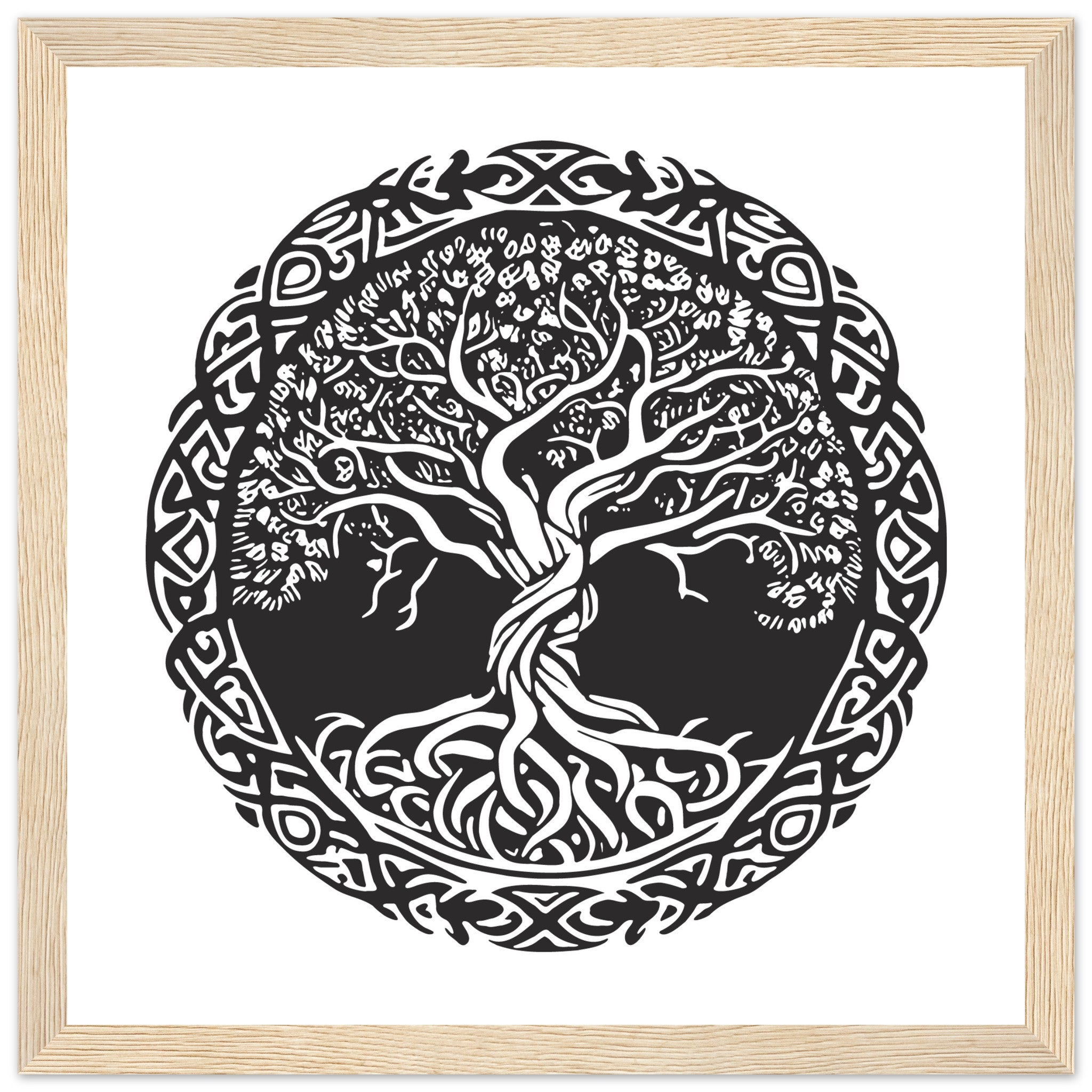
We print Celtic designs on archival matte paper, framed or unframed, made to order and shipped worldwide. There are two Tree of Life designs here, and they are not the same picture:
- The Crann Bethadh — the Irish tree, root and branch closing into a single unbroken ring.
- Yggdrasil in Celtic knotwork — the Norse world tree drawn in the Irish idiom, where the two mythologies meet.
Or browse the full Celtic Designs collection and our Mythology prints.
A companion piece: Celtic art — what is actually Irish about it, on the Tara Brooch, the Broighter gold, and which parts of the knotwork are actually native.
Sources: Fergus Kelly, "Trees in early Ireland" (Irish Forestry), on Bretha Comaithchesa, the four grades, the seven nobles of the wood, the fines, the bile and fidnemed, the five great trees of the Dindshenchas, and the Annals of Ulster entries for 996, 1099 and 1111.